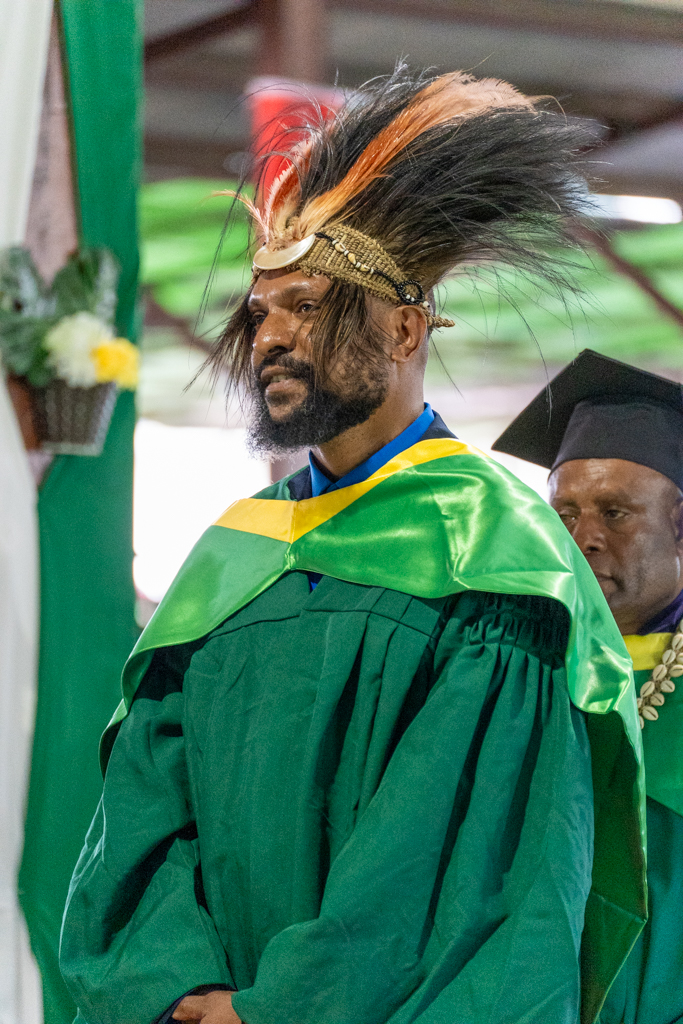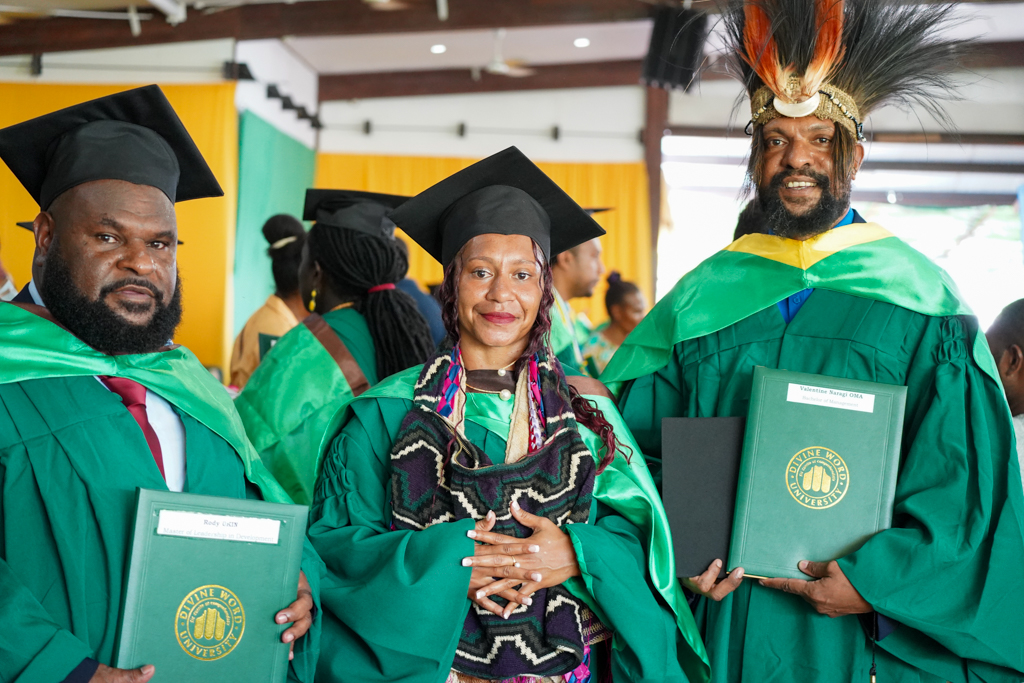
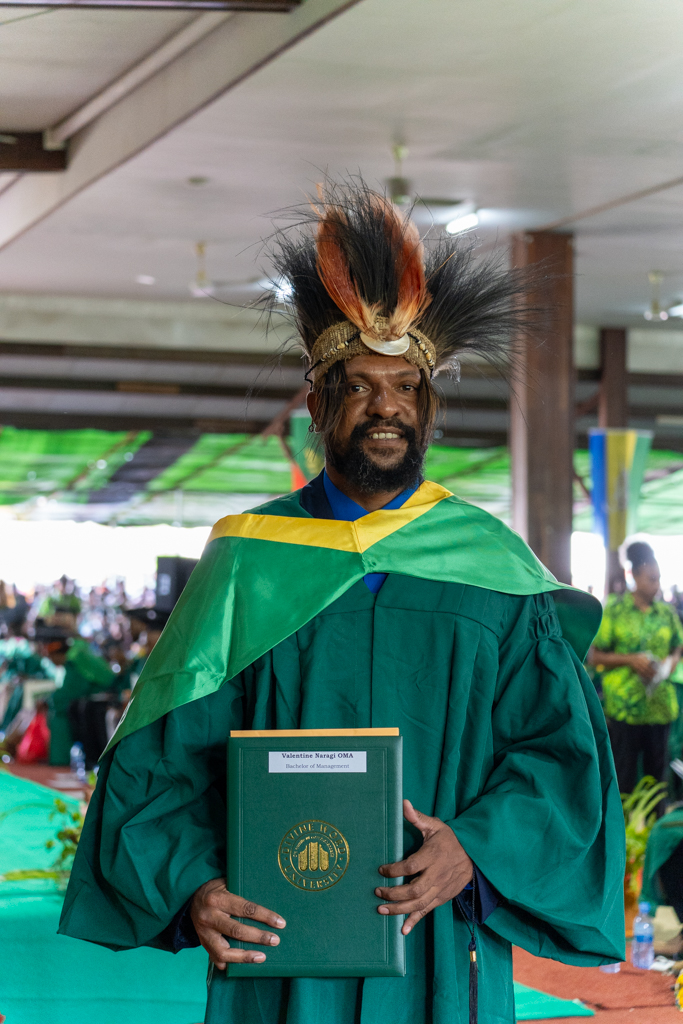
Valentine Naragi, from Parama Island in the Kiwai Rural Local Level Government, South Fly District, Western Province, graduated with a Bachelor of Management from Divine Word University on March 6, 2026. His studies were sponsored by the Mineral Resources CMCA trustee, a subsidiary of the Mineral Resources Development Company.
The quiet and thoughtful Parama islander speaks of this achievement as a credential earned on behalf of the people of Parama, whose belief in him made this mission possible.
“This degree belongs to my family, my village, and the MRCMCA trustee who believed Western Province boys like me could carry responsibility and bring it home.”
Beginning as a trainee at Telikom PNG in 2011, he progressed through roles with Swire Shipping, Consort Express Lines, ANL Agencies, and later Barlow Industries Limited in Lae, where he works as an Overseas Documentation Coordinator.
It was during those years coordinating shipments and verifying cargo that a persistent question began to follow him: how could Western Province, a region generating billions in resource revenue, still remain so starkly underdeveloped while its people continued to wait for small payouts? This question directed him toward formal study, seeking strategic knowledge to complement the operational skills he was already mastering.
Studying while working full time demanded discipline, reflected in his strong academic results which include a High Distinction in Marketing Management and Research, a Distinction in Operations and Quality Management, and consistent performance across strategic, entrepreneurial, and management courses.
He believes this knowledge can be translated into tools to advance his people. “I want us to move from waiting culture to building culture,” he says. “Register the SME. Save a little every week. Budget well. Start small and stay consistent. That is how we turn payouts into livelihoods.”
Support from the MRCMCA Company through the MRDC Education Subsidy Program reminded him that Western Province was watching, hoping, and investing. The subsidy removed the weight of tuition fees, allowing him to direct his salary toward family support, but more importantly, it gave him a deep sense of accountability.
“When your own people pay for your education, you wake up different,” he reflects. “You study because they are counting on you.”
MRDC Managing Director Augustine Mano placed Valentine’s achievement within a broader purpose.
“Education is the dividend that compounds,” Mr Mano said. “When landowners invest in a son or daughter’s learning, we are growing leaders who turn royalties into real outcomes for families. That is why the Education Subsidy Program exists, to support impacted communities and build capacity. Our commitment is simple. The returns on education must show up in villages through small businesses, transparent governance, and young people who see a pathway. Graduates like Valentine prove that when we back potential, communities move forward.”
Valentine does not ignore the realities at home. He speaks clearly about concerns around misappropriation, slow infrastructure development, inflated goods and services pricing, and rising social issues including domestic violence and gaps in health and policing services. None of these intimidate him. Instead, they deepen his conviction that young educated Papua New Guineans from Western Province must be part of the solution.
With fourteen years of professional experience, he plans to use his expertise to help villagers coordinate the production of fish, sago, cocoa, copra, and other commodities so they can access markets not only in Lae and Port Moresby but potentially in the Torres Strait under renegotiated village treaty arrangements.
He imagines his people permitted to conduct micro trading on Thursday Island, selling arts, crafts, and produce in ways that strengthen household incomes. He wants to encourage clan leaders to convert annual royalty and equity payments into investment vehicles that can purchase real estate, establish SMEs, or build income generating assets instead of distributing small sums that disappear quickly.
“Let us turn K150 payouts into shared capital,” he says. “Into boats that move product, freezers that hold fish, mills that process sago, and cash flows that last beyond one distribution cycle.”
MRDC General Manager for External Affairs Barthemelow Yackop, who attended the graduation, underscored the practical link between study and service.
“This is what partnership with landowners is meant to look like,” Mr Yackop said. “A young professional with real sector experience earns a qualification and takes it home, into savings groups, cooperatives, logistics networks and market access. Our role is to keep the bridge strong. Sponsorship that removes barriers, mentoring that stays with graduates, and follow through so communities feel the impact.”
Valentine also sees a need for transparent financial education. His experience in compliance and documentation at Barlow Industries has shown him the importance of clear audit trails. He envisions developing simple visual explanations of how CMCA funds move, how percentages are allocated, and what projects are intended to be delivered, materials that can be understood without formal financial training.
He believes that the more clearly communities understand numbers, the more confidently they can participate in decision making. “If people can see the flow on one page, they can ask the right questions,” he says. “That is how accountability becomes normal.”
He carries an equal passion for youth mentorship. Having once been a student who faced setbacks and returned to university after years in the workforce, he wants to show students from Western Province that a pathway exists beyond Grades 8, 10 or 12.
“Someone showed me a path,” he says. “Now I want to stand at the bend in the road and do the same for the next one coming.”
For now, he continues at Barlow Industries, knowing that the corporate networks and logistics experience he gains will eventually benefit Western Province. He sees opportunities for Barlow to support the province by supplying structural materials for roads, bridges, and other infrastructure when he eventually returns home.
Over the next few years, he hopes to transition into roles with the OK Tedi Development Fund, Sustainable Development Program, MRDC development programs, or local and provincial government, bridging corporate expertise with community needs.
Further ahead, he dreams of creating a Western Province Community Enterprise Network, a network of village owned production hubs supplying domestic and international markets with fish, sago, cocoa, copra, rubber, timber, and handcrafted goods. Alongside this, he imagines tourism ventures across the Delta, Middle Fly, and North Fly, and sees potential for Daru Port to evolve into a major Pacific transshipment hub.
He wants children along the Fly River to pursue education confidently, mothers to sell processed sago at fair value, and young people to build income streams of their own.
“The real ceremony,” he says, “is the day a mother sells her sago at a fair price because the system finally works for her.”